Welcome
Mathematics & computer science applied to data
Université Laval — Québec
Maths + code to understand, predict and secure real-world systems.

This week
New — two articles on vector-valued time series. First the foundation: multivariate time series, where a zero contemporaneous correlation turns out to hide a dependence of −0.76 three lags away. VAR processes, the stationarity condition on the unit circle, and the prewhitening trap. Then the sequel: cointegration, measuring live why a regression between two independent random walks looks significant in more than 80% of cases. Four interactive simulators, and Python cells that run directly in the page.
Last week
Generalized Additive Models. How to let the data choose the shape of a relationship without overfitting: spline bases, the roughness penalty, effective degrees of freedom, and selecting λ by generalized cross-validation. Six animations, and Python cells that run directly in the page.
Highlights
Copula Laboratory
Interactive simulation of dependence structures: five copula families, tail dependence, and Sklar's theorem in real time.
Open the lab →Zero → One Lab
Six ideas from Zero to One (Thiel & Masters) restated as models: the power law, competitive erosion, Pólya urn, secrets and the 10x rule.
Open the lab →Fractal Explorer
GPU visualization of Mandelbrot and Julia sets. Infinite zoom into the complex dynamics z² + c.
Explore →Time Series
Supervised formulation, walk-forward validation, baselines and multi-step strategies.
Read →Alimentrace
Agri-food traceability built to work offline: from the African producer to the exporter, with proof of EUDR compliance. Co-founder and CTO — in field validation.
See the project →Posters
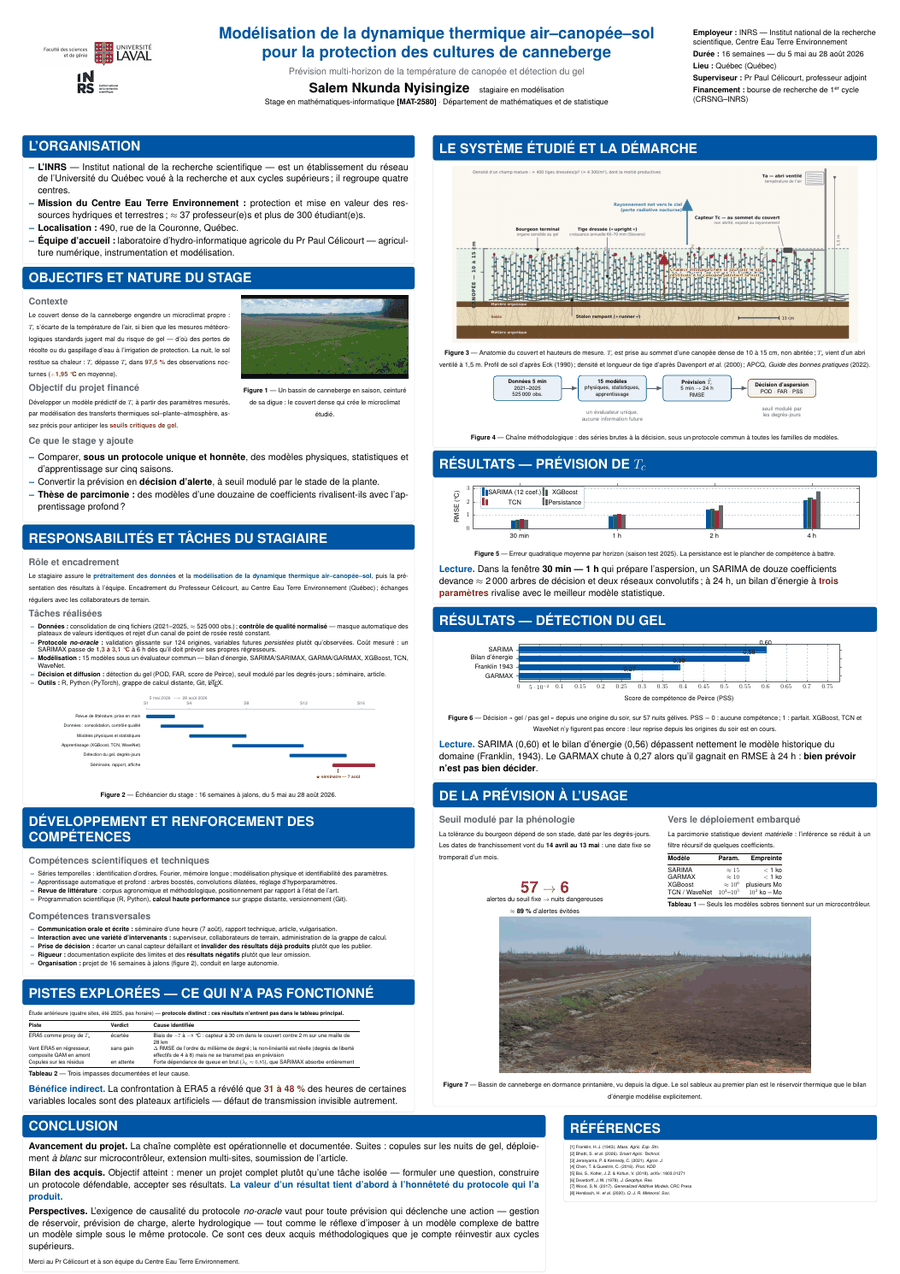
Air–canopy–soil thermal dynamics — cranberry
INRS internship (MAT-2580): canopy temperature forecasting and frost detection. 15 models under a shared no-oracle protocol — a twelve-coefficient SARIMA beats ≈ 2,000 decision trees at short horizons.

Contact
📍 Québec, Canada